The Reality of Running a Fund Across Multiple Jurisdictions
A GP running a Cayman-domiciled fund with a Singapore management entity, Hong Kong SFC licensing, US FATCA obligations, and EU AIFMD reporting requirements is not dealing with four markets. They are dealing with four compliance calendars, four regulatory bodies, and four reporting formats that do not coordinate with each other.
The instinct is to manage this with headcount, a route that is expensive and hard to scale. Multi-jurisdiction compliance is not a resourcing problem. It’s an infrastructure issue. Firms that treat it as infrastructure build a structural advantage. Those that eventually get overwhelmed by it.
Why Multi-Jurisdiction Compliance Has Become Structurally Harder
Over the past five years, we’ve witnessed three forces that have compounded the challenge of multi-jurisdiction compliance:
- Regulatory proliferation. The filing burden has deepened materially across every major fund jurisdiction. FATCA and CRS reporting requirements have expanded. As of 2025, 116 jurisdictions have commenced CRS exchanges, with 126 of 171 Global Forum members committed to implementation. This covers over 171 million financial accounts valued at nearly EUR 13 trillion annually. MAS has increased supervisory scrutiny and raised expectations under Notice SFA04-N02, particularly around risk management, AML/CFT, and operational controls. The SFC continues to expand governance expectations under the Fund Manager Code of Conduct. AIFMD II, finalized in 2024, adds new liquidity management and delegation disclosure obligations for any fund marketed to EU investors.
- Core complex fund structures. A single fund vehicle can now touch five or six jurisdictions simultaneously: a Cayman LP, a BVI feeder, a Singapore GP entity, Luxembourg SPVs for EU access, and portfolio companies in multiple markets. Each structural layer carries its own compliance obligations.
- LP diversity. US pension funds, EU institutional investors, Middle East sovereign wealth, and Hong Kong family offices each bring distinct regulatory footprints into the fund. What satisfies a FATCA qualified purchaser requirement is different from what a CRS-participating European institution needs, which differs again from what a Cayman-domiciled LP requires.
| 117+ jurisdictions committed to CRS automatic exchange as of 2023 (OECD)
30% FATCA withholding penalty on non-compliant payments (IRC Chapter 4) 2024 AIFMD II finalized, adding new obligations for EU-marketed funds |
The Operational Cost of Getting It Wrong
Non-compliance carries immediate financial consequences and remains a material enforcement priority for global regulators. Under FATCA, non-participating financial institutions may be subject to a 30% withholding tax on US-sourced payments, effectively restricting access to key capital flows.
For instance, under the Common Reporting Standard (CRS), penalties vary by jurisdiction, with markets such as Thailand imposing fines of up to THB 500,000 for inaccurate reporting. More broadly, enforcement activity has intensified: regulators issued approximately $1.23 billion in fines across 139 actions in the first half of 2025 alone, a 417% year-on-year increase, while global penalties reached around $3.8 billion for the full year.
North American regulators accounted for the majority of enforcement, issuing over $1 billion in penalties in H1 2025. Authorities such as the Monetary Authority of Singapore and Hong Kong’s Securities and Futures Commission have also increased scrutiny of reporting accuracy, with institutions facing not only financial penalties but also remediation orders, supervisory escalation, and reputational damage that often exceeds the direct cost of fines.
The less visible cost is operational drag. LP onboarding slows as tax documentation is chased. Capital call timelines slip while NAVs are finalized. Audit cycles stretch as data sits across disconnected systems. Many fund managers still rely on spreadsheets for parts of compliance tracking, increasing the risk of errors at each step.
Managing compliance through headcount alone does not scale. Each new fund, investor jurisdiction, or regulatory requirement adds pressure to already stretched teams. The issue is not resourcing. It is infrastructure.
What a Strong Compliance Framework Looks Like
There is no single regulatory fix. But there is a structural approach that scales, built on three pillars.
Pillar 1: Centralized data, jurisdiction-specific outputs
Investor and fund data should sit in a single source of truth. A Common Reporting Standard report for Singapore’s IRAS, a FATCA filing for the IRS, and an AIFMD Annex IV report for a European regulator should all draw from the same underlying dataset. Each manual data transfer increases the risk of error.
Pillar 2: Automated compliance calendars
Multi-jurisdiction operations require a consolidated view of regulatory deadlines across all authorities. Tracking obligations separately by jurisdiction creates unnecessary strain. When deadlines are visible early, late filings become less frequent. When obligations are visible before they become urgent, late filings drop significantly.
Pillar 3: Clear accountability structures
It’s good to have someone own the compliance posture for each jurisdiction, explicitly. In lean GP teams, this is where an outsourced administrator with genuine multi-jurisdiction depth becomes critical. The question is not whether to outsource but whether the administrator has operational capability in your investors’ home jurisdictions, not just licensing on paper. Linnovate’s regulatory compliance services are built around this distinction, with jurisdiction-specific depth across Asia-Pacific and key international fund domiciles.
Technology as Infrastructure, Not a Band-Aid
Many fund managers have layered point solutions on top of broken workflows: a separate FATCA/CRS filing tool, a different investor reporting system, a spreadsheet for everything else. Each tool solves one problem while creating data gaps at every junction. Research shows that in some firms, operations teams spend up to 40% of their time reconciling data across systems rather than performing value-added work
Real compliance infrastructure means data flows without manual intervention. Investor onboarding and tax classification feed directly into regulatory reporting, which feeds into jurisdictional filings, all from a single source of truth. When a new LP is onboarded, their tax status and classification populate every compliance output automatically.
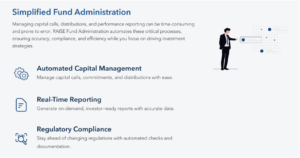
This is the architecture behind RAISE, Linnovate’s fund operations platform. RAISE integrates investor data management, FATCA/CRS automation, regulatory reporting, and LP communications into one environment built for managers operating across multiple jurisdictions. The goal is not just to digitize manual processes but eliminate manual intervention entirely.
Practical Steps for GPs Managing Cross-border Complexity Today
Cross-border compliance challenges are operational, not theoretical. Most gaps emerge in execution rather than policy. For GPs managing multiple jurisdictions, the focus shifts from understanding the regulations to building systems that can reliably meet them in practice. These steps bring structure to that complexity and reduce avoidable operational risk.
Step 1: Map your compliance obligations by jurisdiction and maintain that register.
If you cannot see all obligations across all jurisdictions in one view, you cannot manage them proactively. The register should include deadlines, responsible parties, and the format required by each authority. Fragmented tracking is the most common source of late filings.
Step 2: Audit where data duplication is occurring.
Every time investor data such as tax residency, classification, or account details is re-entered into multiple systems, you introduce unnecessary risk. Map the full flow from onboarding through to reporting and filings, and pinpoint where data is being manually re-keyed or transferred. Linnovate’s reporting services are designed to remove these duplication points across FATCA, Common Reporting Standard, and multi-jurisdiction investor reporting.
Step 3: Evaluate your administrator’s jurisdiction coverage in practice.
Many administrators are licensed in multiple jurisdictions, but licensing alone does not guarantee execution capability. What matters is operational depth: local regulatory expertise, established relationships with authorities, and proven experience handling filings under specific regimes. GPs should directly assess FATCA/CRS experience across their LP base, familiarity with frameworks such as MAS and SFC requirements, and how the administrator responds when regulatory rules change mid-cycle.
Conclusion
Multi-jurisdiction compliance is an operational infrastructure challenge, not a regulatory one. Funds that build the right data and systems foundation make compliance a process. Those that treat it as paperwork add disproportionate operational burden with every fund launch, every new LP, and every regulatory update.
As FATCA/CRS enforcement deepens, AIFMD II obligations take effect, and MAS and SFC scrutiny increases, the gap between operationally ready firms and those managing compliance manually will widen. The time to close it is before a deadline is missed or an LP raises a governance concern.
Managing compliance across multiple jurisdictions? Speak to the Linnovate team about cross-border fund operations: linnovatepartners.com/contact-us